
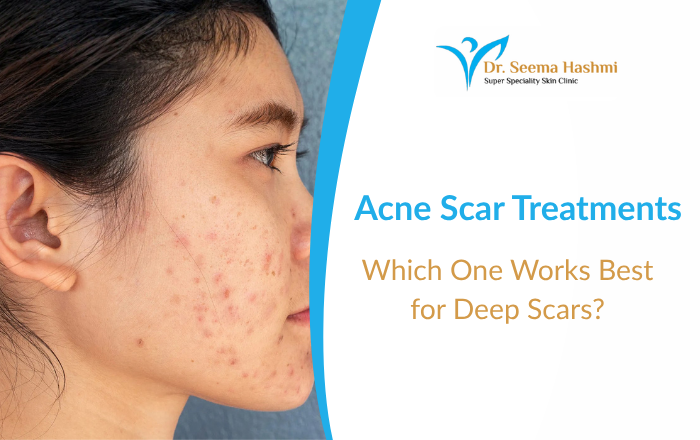
You finally got your acne under control. The breakouts slowed down, your skin started to calm — and then you looked in the mirror and noticed something that wouldn’t budge: deep, pitted scars left behind like unwanted reminders. If this sounds familiar, you’re not alone.
Acne scar treatment is one of the most searched skincare topics today — and for good reason. Nearly 95% of people who experience acne develop some form of scarring. For many, those scars go deeper than the surface, affecting confidence, self-image, and even daily life. The good news? Deep acne scars are very much treatable. This blog breaks down everything you need to know in simple language.
What Are Deep Acne Scars — And Why Won’t They Just Fade?
Not all acne marks are the same. That dark spot left after a pimple heals? That’s post-inflammatory hyperpigmentation — it usually fades on its own with time. But deep acne scars are a different story altogether.
Deep scars happen when acne damages the skin’s collagen during the healing process. Instead of healing smoothly, the skin fills in unevenly, creating pits, dips, or indentations. These don’t fade with moisturizer or time — they need targeted treatment.
The 3 Types of Deep Acne Scars You Should Recognize
- Icepick scars — Narrow, deep holes that look like the skin was punctured. These are the hardest to treat.
- Boxcar scars — Wide, crater-like depressions with defined edges. Common on the cheeks and temples.
- Rolling scars — Wavy, uneven skin texture caused by fibrous tissue pulling the skin downward from beneath.
Knowing your scar type matters because different scars respond better to different treatments.
The 7 Most Effective Treatments for Deep Acne Scars
1. Microneedling — The Most Popular Treatment Right Now
Microneedling for acne scars works by using tiny needles to create controlled micro-injuries in the skin. This signals the body to produce fresh collagen — the protein responsible for smooth, firm skin.
It’s best suited for rolling and boxcar scars, and most people need 3–6 sessions. Studies show it can improve deep acne scar appearance by up to 50–70%. Downtime is minimal — just a day or two of redness. It’s also one of the safest options for all skin tones, including Indian skin.
2. Chemical Peels — Resurface Your Skin Layer by Layer
Chemical peel treatment for acne scars uses acids like glycolic, salicylic, or TCA to remove the top layers of damaged skin, encouraging fresh skin to surface.
Peels work well for mild-to-moderate boxcar scars and uneven skin texture. Deeper peels give stronger results but need professional supervision. This is not a one-time fix — a series of sessions gives the best outcome.
3. Laser Resurfacing — Target Scars With Precision
Laser treatment for acne scars uses focused light energy to either remove damaged skin tissue (ablative laser) or stimulate collagen from beneath the surface (non-ablative laser).
Ablative lasers give dramatic results but come with 5–10 days of downtime. Non-ablative options are gentler with less recovery time. Laser works particularly well on icepick and deep boxcar scars. Important note: not all lasers are suitable for darker skin tones — always consult a dermatologist first.
4. Subcision — The Underrated Fix for Rolling Scars
If you have rolling scars, subcision could be exactly what you need. A fine needle is inserted under the scar to break the fibrous tissue that pulls the skin downward, releasing the scar and allowing it to rise to a normal level.
Subcision for acne scars is often combined with microneedling or fillers for even better results. It’s highly effective and doesn’t get talked about nearly enough.
5. Dermal Fillers — Instant Improvement for Sunken Scars
Hyaluronic acid fillers can be injected into depressed scars to plump them up and make the skin surface appear smoother almost immediately.
This is a good option for isolated deep scars, but it’s important to know the results are temporary — lasting 6 to 18 months. Dermal fillers for acne scars are often used as part of a combination approach, not as a standalone solution.
6. PRP Therapy — Heal Your Skin From the Inside Out
PRP, or Platelet-Rich Plasma therapy, uses your own blood — processed to concentrate growth factors — and injects it back into the scarred areas to stimulate natural healing and collagen production.
PRP treatment for acne scars is growing fast in popularity because it uses the body’s own healing ability. It’s also very safe for Indian and darker skin tones. When combined with microneedling (often called a “vampire facial”), results are noticeably improved.
7. Punch Excision — For the Deepest, Narrowest Scars
For very deep icepick scars that don’t respond to anything else, punch excision is a minor procedure where the scar is physically cut out and the wound closed. The small mark left behind is much easier to treat with resurfacing afterwards.
It sounds intense, but for the right type of scar, it’s the most direct and effective solution available.
At-Home Care: What Helps and What Doesn’t
Let’s be honest — no cream is going to fix deep structural scars. But certain ingredients do support gradual improvement in texture and tone:
- Retinoids (Tretinoin): Boost cell turnover and help with surface texture
- Niacinamide: Reduces pigmentation and improves overall skin tone
- Vitamin C: Brightens and supports collagen production
- AHAs/BHAs: Gentle exfoliation to keep skin fresh
Use these as part of your daily routine — and always wear SPF. Sun exposure darkens scars and slows down healing significantly.
How to Choose the Right Treatment for Your Skin
There is no single “best” acne scar treatment that works for everyone. The right choice depends on your scar type, skin tone, budget, and how much downtime you can manage. Combination treatments — for example, subcision followed by microneedling and PRP — often deliver the most noticeable results.
This is exactly why a dermatologist’s guidance is so important before spending money on any treatment.
Ready to Finally Take Action on Your Scars?
If you’ve been living with deep acne scars and feel unsure where to start, you don’t have to figure it out alone. Dr. Seema Hashmi at Dr. Skin Solution Skin Clinic in Kondhwa, Pune helps patients find the right acne scar treatment path based on their specific skin concerns and scar types. Whether you need microneedling, laser, or a combination approach, a proper consultation can save you both time and money.
Book your appointment today and take the first real step toward clearer, smoother skin.
FAQs
Q1: Can deep acne scars be completely removed?
Most deep scars can be improved by 50–80% with the right treatment. Complete removal isn’t always possible, but the improvement can be genuinely life-changing.
Q2: How many microneedling sessions do I need?
Typically 4–6 sessions spaced 4 weeks apart, depending on how deep the scars are.
Q3: Is acne scar treatment painful?
Most treatments involve mild discomfort. Numbing cream is usually applied beforehand to keep you comfortable.
Q4: Are these treatments safe for Indian skin tones?
Yes , especially microneedling and PRP. Always let your dermatologist know your skin tone and history before starting laser treatments.