
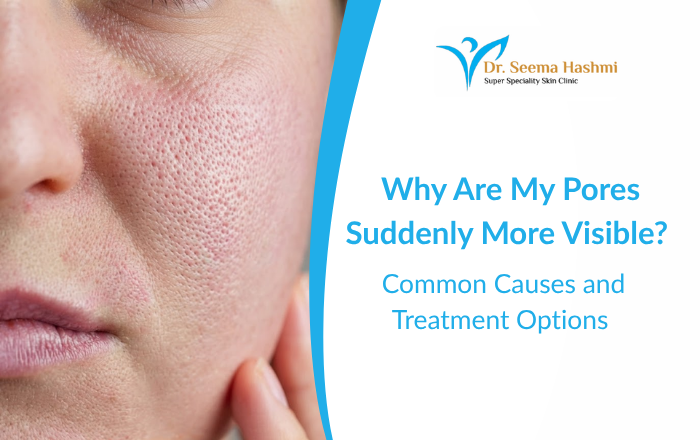
You look in the mirror one morning and the pores on your nose, cheeks or forehead seem bigger than you remember. Makeup settles into them, the skin looks uneven, and you start wondering what changed. Enlarged pores are one of the most common skin concerns people bring to a dermatologist, and in most cases they are not a sign of anything serious.
Pores usually become more noticeable because something around them has changed: more oil, clogged openings, sun damage, loss of firmness in the surrounding skin, or a routine that is irritating the skin. Working out which of these applies to you is the first step towards making them look smaller.
Why Are My Pores Suddenly More Visible?
Pores often look suddenly larger when oil production increases, when they fill with dead skin and sebum, or when the skin around them loses firmness. Hormonal shifts, hot and humid weather, new skincare or makeup products, sun exposure and acne flare-ups are among the most common triggers.
Every pore is the opening of a hair follicle, and most facial pores are attached to oil glands. Their size is set largely by genetics, but how visible they are can change a lot. A pore stretched by trapped oil, or surrounded by skin that has become less elastic, casts a slightly bigger shadow and catches the eye more easily.
Many patients describe these as open pores. The term is widely used, but pores don’t actually open and close like doors. Their appearance simply becomes more or less noticeable depending on what is happening in and around them.
Common Causes of Enlarged Pores
1. Excess oil (sebum)
People with oily skin tend to have more visible pores, particularly on the nose, forehead and chin. Larger oil glands and higher sebum output are closely linked to pore size. Oil also reflects light, which makes the skin’s surface, pores included, look more prominent.
2. Acne, blackheads and clogged pores
When dead skin cells and sebum collect inside a pore, they can stretch its opening. Blackheads make this even more obvious because the dark plug shows up clearly against the skin. Repeated breakouts and inflammation can also leave behind texture changes. If acne is part of the picture, our guide on what causes adult acne may help.
3. Sun exposure
Ultraviolet (UV) light gradually breaks down collagen and elastin, the proteins that keep the skin firm. Over time, the skin around each pore offers less support, and the opening can appear wider. Long-term sun exposure also thickens the outer skin layer and makes texture look rougher. In a country like India, where many people spend time outdoors without daily sunscreen, this is a cause that is easy to overlook.
4. Ageing and loss of skin elasticity
Pores often look larger with age. Collagen production slows down, the skin becomes less firm, and gravity pulls slightly on the pore openings so they look more elongated, especially on the cheeks.
5. Hormonal changes
Androgens stimulate oil glands, so changes in hormone levels can affect how oily the skin becomes. Many people notice more visible pores during puberty, around their menstrual cycle, during pregnancy or with conditions such as PCOS. Some hormonal medicines can have a similar effect.
6. Pore-clogging products
Heavy creams, oily sunscreens, thick foundations and certain hair oils that drift onto the forehead can block pores. Makeup that isn’t removed properly at night does the same thing.
7. Harsh or excessive cleansing
Scrubbing, using strong face washes several times a day or relying on alcohol-heavy toners can irritate the skin and damage its protective barrier. Irritated skin often looks red, rough and uneven, which makes pores stand out.
8. Heat, humidity and pollution
Sweat and humidity, common during Indian summers and the monsoon, can increase shine and make oily skin look oilier. Pollution particles can settle on the skin and mix with sebum, adding to dullness and congestion.
9. Genetics
Some people simply inherit larger pores. This is normal, and it is helpful to know when setting expectations for treatment.
Can Dehydration Make Pores Look Bigger?
Dehydration does not enlarge pores, but it can make them look more noticeable. Skin that lacks water often appears dull and slightly rough, and fine surface lines become more visible. This uneven texture draws attention to pores.
Some people with oily skin skip moisturiser, thinking it will make things worse. A lightweight, non-comedogenic moisturiser usually helps the skin look smoother and supports a healthy skin barrier.
Can You Actually Shrink or Close Your Pores?
You cannot permanently close pores, and their basic size is largely set by genetics. What you can do is make them look smaller by keeping them clear, controlling excess oil, protecting the skin from sun damage and improving firmness in the surrounding skin.
It helps to separate two kinds of improvement:
- Temporary improvement: products such as primers, clay masks or cold water can make pores look smaller for a few hours, but the effect wears off.
- Gradual, longer-lasting improvement: regular sunscreen, suitable active ingredients and some in-clinic procedures can improve skin texture over weeks to months. Results vary from person to person, and maintenance is usually needed.
How to Minimise Pores at Home
A simple, consistent routine often makes a noticeable difference. Not every product suits every skin type, so introduce new ingredients one at a time.
- Cleanse gently, twice a day. Use a mild cleanser suited to your skin type. Wash after sweating or exercise, but avoid scrubbing.
- Choose non-comedogenic products. Look for this label on moisturisers, sunscreens and makeup. Remove makeup completely before bed.
- Wear sunscreen every day. A broad-spectrum sunscreen of SPF 30 or higher helps protect collagen and limits UV damage. Gel or matte formulas tend to suit oily skin.
- Keep moisturising. Lightweight gel or water-based moisturisers work well for oily and combination skin.
- Consider salicylic acid. This oil-soluble exfoliant can help clear debris from inside pores and may suit people with blackheads or oily skin. It can cause dryness or irritation in some people.
- Consider a retinoid. Over-the-counter retinol, or prescription retinoids recommended by a doctor, can help with clogged pores and gradually improve skin texture. Retinoids are generally avoided during pregnancy, and they can irritate sensitive skin, so medical advice is sensible before starting.
- Don’t squeeze or pick. Squeezing blackheads or pimples can push debris deeper, cause inflammation and leave marks or scars.
If you have sensitive skin, eczema, rosacea, active acne or are pregnant or breastfeeding, check with a dermatologist before adding strong active ingredients.
Enlarged Pores Treatment: Professional Options
When home care isn’t enough, a dermatologist can suggest procedures based on what is causing your pores to look larger. Treatment choice depends on your skin type, acne activity, pigmentation, scarring and age-related changes. No single option suits everyone.
Chemical peels
A chemical peel uses acids such as salicylic or glycolic acid to remove the outer layer of dead skin. Peels can help clear congested pores, reduce oiliness and smoothen texture. A series of sessions is usually needed.
Prescription topical treatments
For pores linked to acne or oily skin, a dermatologist may prescribe topical retinoids or other acne treatments. These need to be used as directed, as irritation is common at the start.
Microneedling and MNRF
Microneedling creates tiny controlled channels in the skin to stimulate collagen. When combined with radiofrequency energy, as in MNRF treatment, it may also help with pore appearance and acne scars. Temporary redness and swelling are expected after sessions.
Laser treatments
Fractional lasers and other skin laser treatments can improve texture and stimulate collagen. Darker skin tones need careful laser selection and settings because of the risk of pigmentation changes.
Treating the underlying cause
If acne is driving the problem, controlling breakouts with appropriate pimple treatment often helps pores look better too. Where loss of firmness is the main issue, collagen-supporting options may be considered.
When Should You See a Dermatologist?
Visible pores alone are not usually a medical concern. A dermatologist can help if:
- Your pores have changed noticeably in a short time without an obvious reason
- You have frequent breakouts, painful pimples or many blackheads
- Over-the-counter products haven’t helped after two to three months of regular use
- Your skin is becoming irritated, red or sensitive with products you use
- You also notice acne scars, pigmentation or uneven texture
- You are considering peels, lasers or other procedures and want to know what suits your skin
- You have other symptoms, such as irregular periods or sudden excess facial hair, alongside very oily skin
Frequently Asked Questions
1. Why are my pores suddenly visible?
Increased oil production, clogged pores, hormonal changes, hot and humid weather, new products and sun damage are common reasons. Sometimes more than one factor is involved.
2. Do pores get bigger with age?
Pores often look larger with age because the skin loses collagen and elasticity, so the support around each pore weakens. Long-term sun exposure speeds up this process.
3. Can oily skin make pores look larger?
Yes. Oily skin and enlarged pores are closely linked. More sebum can stretch the pore opening, and shiny skin makes pores easier to see.
4. Can I permanently close my pores?
No. Pores can’t be permanently closed. Their appearance can be reduced with good skincare and, where appropriate, dermatological treatments.
5. Does sunscreen help with visible pores?
Yes. Daily sunscreen helps protect the collagen that supports pores, which may prevent them from looking larger over time.
Get Your Pores Assessed by a Dermatologist
If your pores have suddenly become more noticeable, or skin texture changes are bothering you despite a steady routine, a dermatologist can look at the underlying cause and guide you towards suitable options.
You can book a consultation with Dr. Seema Hashmi, MBBS, DDV, an experienced Dermatologist & Cosmetologist, at Dr. Seema Hashmi Super Speciality Skin Clinic, Pune.
Name: Dr. Seema Hashmi Super Speciality Skin Clinic
Led by: Dr. Seema Hashmi, MBBS, DDV, Dermatologist & Cosmetologist
Address: Off No 111, AMC Avenue, NIBM Annexe, opp. RAHEJA VISTAS PHASE-3, Autadwadi Handewadi, Mohammed Wadi, Pune, Maharashtra 411060
Phone: 96651 48163